
From the analog two-basket system to digital modular supply: How to achieve a quick win in the hospital.
Modular supply systems in hospitals are far more than just a new cabinet. Learn, based on current data from Fraunhofer IML, how seamless, real-time button operation radically simplifies daily ward routines, prevents duplicate orders, and pays for itself in just 1.6 years.

The pressure on healthcare management is rising inexorably. While severe nursing shortages push frontline staff to their absolute limits, ongoing cost pressures force procurement and logistics managers to operate with maximum efficiency. A central lever to solve both problems simultaneously lies right inside the ward supply room: modular supply management.
Yet, many hospitals face a significant hurdle. Transitioning from time-tested but purely analogue systems to modern workflows often fails due to the complexity of implementation or resistance from the users on the ward. How can module supply management become a genuine “quick-win” that saves time and cuts costs immediately without triggering months of grueling IT projects?
Module Supply Is Far More Than Just a New Cabinet
A common misconception in practice is: “We buy new ISO-modular racks and baskets, and our logistics are optimized.” However, the Fraunhofer IML makes it clear that successful module supply management is far more than the mere procurement of cabinets. It is a holistic logistics and process concept that fundamentally transforms the entire ordering logic and material flow within the hospital.
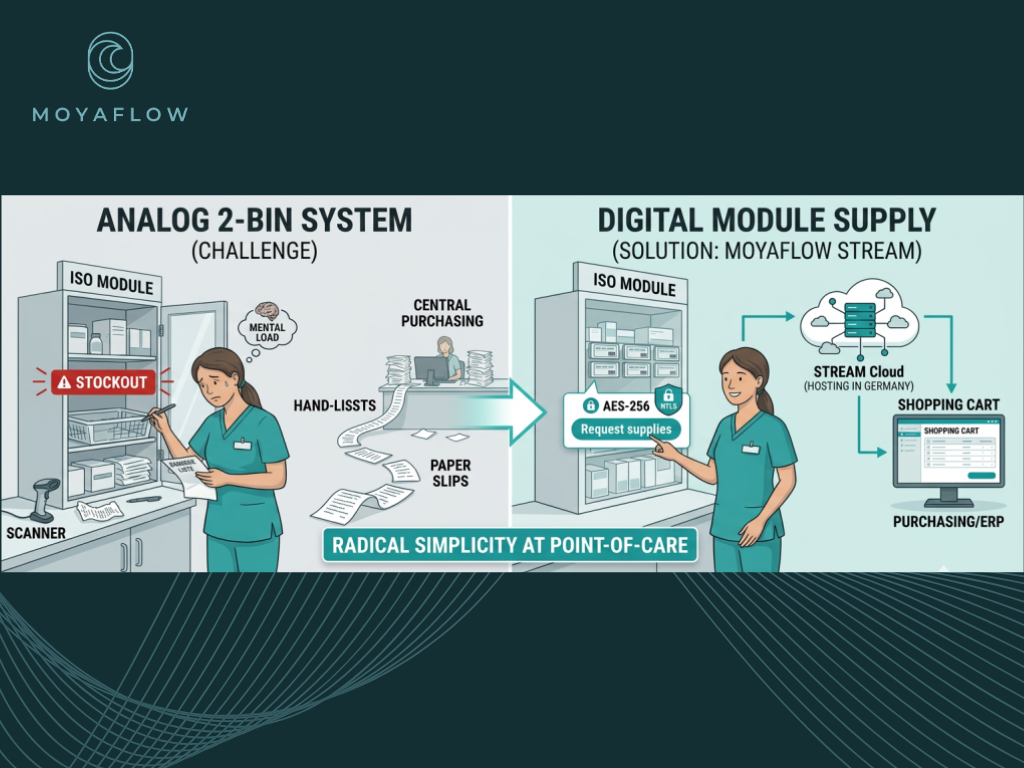
In many hospitals, the classic two-bin system still runs in a completely analogue fashion. In hard numbers, this translates to:
- High search times: According to industry analyses, nursing staff spend up to 15% of their working time on purely logistical tasks, searching for items, and handling manual orders.
- Stockout risks: Because real-time transparency is lacking, manual processes often trigger ad-hoc reorders, which can quadruple the processing costs per item compared to standard automated orders.
- Media breaks: Supply needs are scribbled on paper notes or manually scanned from static barcode lists.
A true quick-win is not achieved by changing the plastic bins. It is achieved through standardized processes, clear target stock levels, and a digital, direct feedback loop into the Enterprise Resource Planning / Material Management (ERP/MAWI) system.
Scientifically Proven: The Optimization Potential in Ward Storage
Unlocking immense potential through this transition is not just a theoretical promise—it is scientifically measurable. In a comprehensive study conducted by the Fraunhofer IML at the Klinikum Oldenburg, the direct impacts of introducing structured module supply management were analyzed in close detail.
By precisely tracking material movement data, order volumes, and ordering frequencies before and after the system overhaul, significant positive effects were documented:
- Creditor Orders: Drastically reduced through smart order bundling and fixed delivery frequencies.
- Ward-Level Inventory: Sustainable optimization through the targeted reduction of hoarding and overstocking.
- Logistics Staffing Requirements: Accurately and reliably predictable thanks to standardized target processes.
Proving that structured module supply can seamlessly integrate these efficiencies into daily clinical routines, the Hannover Medical School (MHH) successfully utilizes this framework across 22 different clinical areas—ranging from the OR and functional units to standard inpatient wards.
The Core Vulnerabilities of Analogue Ward Logistics
Why do analogue systems inevitably hit a wall in modern hospital routines? Because they rely heavily on manual steps that are naturally prone to human error. When orders are placed via adhesive barcodes or manual scanning rounds, specific bottlenecks arise:
- Lack of Transparency: No one knows in real time what has actually been requested until central logistics physically packs the supply cart.
- Duplicate Orders: Out of fear of running out of critical items, staff often re-order manually or press for extra supplies. This causes supply cabinets to overflow, ties up capital unnecessarily, and completely breaks the First-In-First-Out (FIFO) principle.
- High Mental Load: Nurses waste valuable working hours on administrative logistics routines instead of focusing on direct patient care.
The Digital Bridge: Real-Time and Free of Media Breaks
What does the next generation of digital progress look like? The introduction of barcodes and handheld scanners was merely the first evolutionary step. The true modern quick-win completely eliminates the need to search for, print, or scan lists.
Systems like MOYAFLOW STREAM (https://moyaflow.de/en/stream-cloud/) digitize the time-tested two-bin system right at the point-of-care, without burdening the nursing staff with complex software interfaces:
- Real-Time Capture: A single, conscious button press on the Electronic Shelf Label (ESL) instantly transmits the demand to the STREAM Cloud.
- Zero Media Breaks: No paper, no scanner, no manual data entry errors. The workflow is 100% digital and paperless.
- Direct Integration: Data flows seamlessly into the department-specific shopping carts of your existing hospital ERP/MAWI system.
Hard Economic Facts for Procurement Managers
For the chief purchasing officer and kaufmännische Direktion, measurable financial results are what matter most. The advantages of a digitally controlled module supply can be clearly quantified:
- Up to 30% Reduction in Inventory: Thanks to optimized and transparent target quantities, safety stocks are drastically scaled down without ever jeopardizing supply chain security.
- Decreased Capital Lock-up: Freeing up thousands of euros in working capital annually (depending on hospital size) that would otherwise sit decaying in overstocked or expired medical products.
- 100% FIFO Compliance: Far superior control over expiration dates of sterile goods due to a highly structured modular layout.
Conclusion: Measurable Efficiency as a Clear Statement
Real-world experience demonstrates that a modern digital workflow at the supply cabinet rarely fails because of the hardware—it fails due to a lack of user acceptance. If systems are too cumbersome during a stressful shift, staff will simply bypass them.
By radically reducing the process to a single, media-break-free button press directly on the ISO-modular rack, MOYAFLOW bridges the gap between maximum workflow relief on the ward and absolute data transparency for the central procurement team. The fact that such an investment in hospital logistics amortizes in just 1.6 years on average serves as an undeniable kpi for any future-oriented hospital board.